˂div˃`${blue-without-a-name}`˂/ div˃
Blue Without a Name
What humanity may still be unable to distinguish about attention, subjecthood, social reality and the self.
Blue Without a Name: What Humanity Still Cannot Distinguish
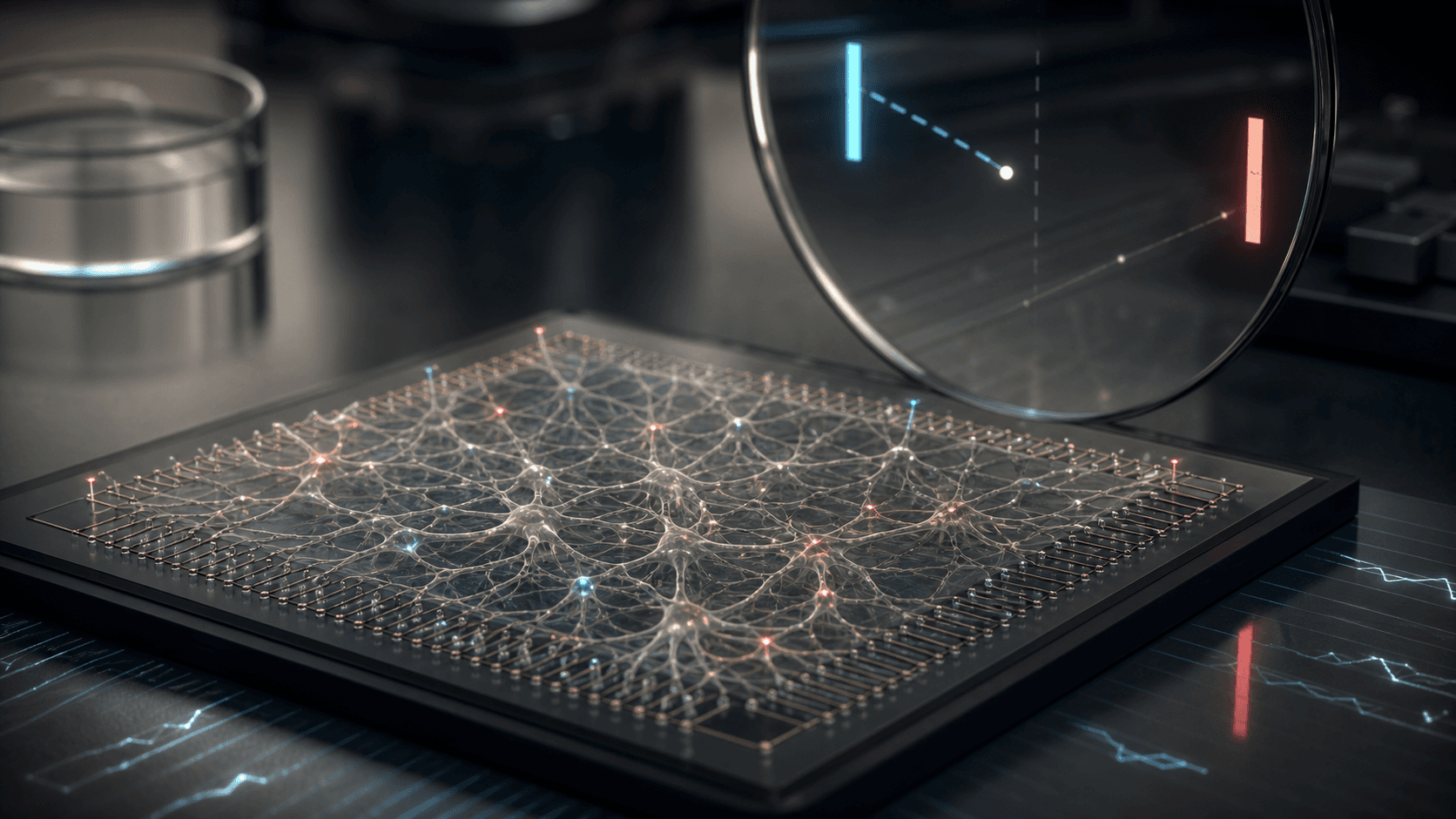
In 2022, the team behind Cortical Labs showed a strange and slightly unsettling experiment: living human and mouse neurons were grown on a microelectrode array, connected to a simple Pong-like environment, and trained through feedback. When the system performed better, the input became more predictable. When it performed worse, the signal became more chaotic.
We should be careful not to humanize this too quickly. It does not mean the cells "liked" or "disliked" anything in the human sense. But the fact itself is striking: even nervous tissue without a body, biography, language, or dopamine-driven motivational system does not look passive. It tends toward a more stable loop between input and output.
That raises a hard question: where is the line between a system that merely adapts and a system that, in some primitive way, experiences a world?
A human is not just a larger version of neurons on a plate. The difference is not only the number of neurons, and probably not only dopamine. A human has a body, hunger, pain, fatigue, memory, social pressure, language, fear of death, a sense of "mine" and "not mine", a long future horizon, and the need to explain itself to other people. Out of this, the "I" may emerge: not as a mystical spark, but as a control model an organism uses to manage itself through time.
There is another layer. We do not perceive the world directly. We perceive it through categories we have learned to separate.
Color makes this unusually visible. Across languages, basic color terms did not always appear in the same order. Blue was physically there all along, but a separate cultural category for it often emerged late. People were not blind to the sky; rather, their language and attention did not mark that boundary as important in the same way.
So the more interesting question is not about blue itself. It is this:
What is around us right now, as obvious as blue, that we still do not know how to distinguish?
1. The Quality of Attention
We still distinguish kinds of attention very poorly. We say someone is focused, distracted, tired, or scrolling. That vocabulary is almost certainly too coarse.
Maybe a century from now, people will have dozens of ordinary words for attention states: attention that scans for threat; attention that builds a model; attention that performs the appearance of work; attention that waits for reward; attention that is anchored in the body; attention that is quietly performing for other people.
Today we often call all of it one thing: concentration.
2. Social Reality as a Physical Environment
We tend to treat "the social" as soft: opinions, relationships, culture. But for a human organism, status, shame, trust, exclusion, and recognition can be almost as real as cold or pain.
We may be underestimating how much the brain uses other people as part of its own regulatory system. The "I" may not be a sealed object. It may be a node in a network of mutual prediction.
3. Different Kinds of Suffering
We have words like sadness, anxiety, depression, stress, burnout. They are useful, but very large. It is as if many shades of blue, green, and gray were all called "dark".
Some states we currently place in the same bucket may be fundamentally different: loss of future, social invisibility, inability to act, chronic suppressed anger, collapse of meaning, lack of a safe witness, disruption of bodily prediction.
We use similar words because we do not yet distinguish the states well enough.
4. Collective Intelligence and Collective Stupidity
We know how to say "a smart person" or "a stupid crowd", but we do not yet see group intelligence clearly as its own phenomenon.
Sometimes a group becomes smarter than any single participant. Sometimes normal people together produce catastrophic stupidity. The difference is often not inside the people. It is in the structure of communication: which errors are allowed, who can object, how status circulates, whether truth or loyalty is rewarded.
We still lack everyday perception for this: this structure produces truth; that structure produces self-deception.

5. Invisible Forms of Addiction
We recognize addictions to substances, games, porn, food, social media. But there may be subtler addictions: to being right, to having an explanation, to emotional drama, to resentment, to the rescuer role, to constant novelty, to a particular image of oneself.
A person can be addicted not only to an object, but to a mode of being themselves.
6. The Body's Inner Interfaces
We still understand poorly how the body participates in thought. Not in the obvious sense that "the body affects mood", but more deeply: part of what we call thought, intuition, decision, or desire may be the brain reading organs, immune signals, breathing, muscle tone, and micro-movements.
We say, "I think." Sometimes a more accurate phrase would be: "My organism proposed an interpretation."
7. Degrees of Subjecthood
Our ladder is very crude: a stone is not a subject, a human is, animals are somewhere in between, AI is debated, organoids are debated. But subjecthood may not be binary.
It may have dimensions: pain, memory, self-regulation, a model of the world, a model of oneself, the capacity to suffer, the capacity to want, the capacity to be disturbed.
Living neurons on a plate point directly at this blind spot. We do not have enough words between "just cells" and "a conscious being".
8. Future Moral Categories
Historically, people often failed to see what later became morally obvious until a category appeared: slavery, children's rights, domestic violence, mental health, consent, burnout.
Something similar may already be near us. Possible candidates: our treatment of animals; old age; children as parental property; human attention as an extractable resource; digital traces of personhood; artificial or biological systems with early forms of experience.
9. The Ecology of Consciousness
We talk about the ecology of nature, but barely about the ecology of the mind. Our environment is now designed at scale to capture attention, intensify comparison, anxiety, desire, anger, and the endless expectation of another stimulus.
Future people may see information pollution as real as air pollution.
For now, we say: "You spend too much time on your phone." That is like calling a poisoned city "a little dusty."
10. The Self Is Not One Thing
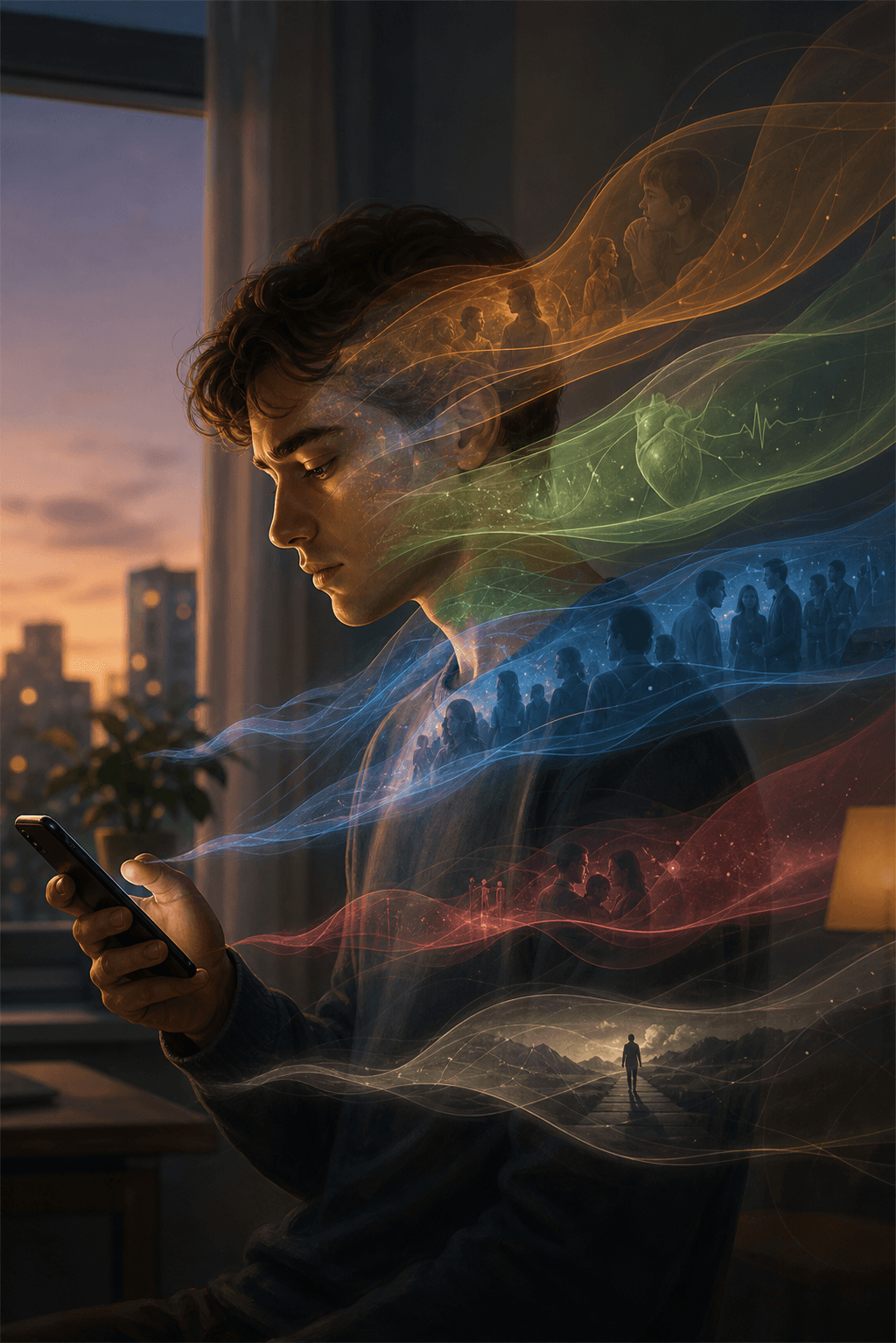
One of the largest unnamed blues may be this: a human is not a single agent in the way it feels like one.
We already know about the unconscious, split-brain cases, competing motivations, internal parts. But culture still asks a person to behave like one solid "I".
Future psychology may not say "a person has a personality". It may say: "a person is a method for coordinating many semi-autonomous processes." Not metaphorically. Literally.
In Short
The largest failures in our knowledge may not come from a lack of information. They may come from a lack of distinctions. We see the symptoms, but name them with words that are too large: stress, motivation, personality, mindfulness, intelligence, normality.
Maybe the strangest blue is not an external object at all.
Maybe it is the fact that we still do not have a good language for the different ways of being ourselves.
Notes
• Cortical Labs / DishBrain paper: Synthetic biological intelligence in a dish (https://www.cell.com/neuron/fulltext/S0896-6273%2822%2900806-6)
• On color terms and language: Basic Color Terms (https://en.wikipedia.org/wiki/Basic_Color_Terms) and MIT News on blue/green emergence in language (https://news.mit.edu/2023/how-blue-and-green-appeared-language-1102)